
Connect sources
Approved account, accounting, invoicing, payroll, CRM or import sources provide known financial facts within their contractual and technical boundary.
AUREL brings known financial information into one explainable picture and uses that foundation for forward liquidity, goal planning, scenario comparison and financial resilience. Intelligence, advice, governance and execution remain explicitly separated: the product line shown performs no live bank actions and is not a credit-scoring engine.
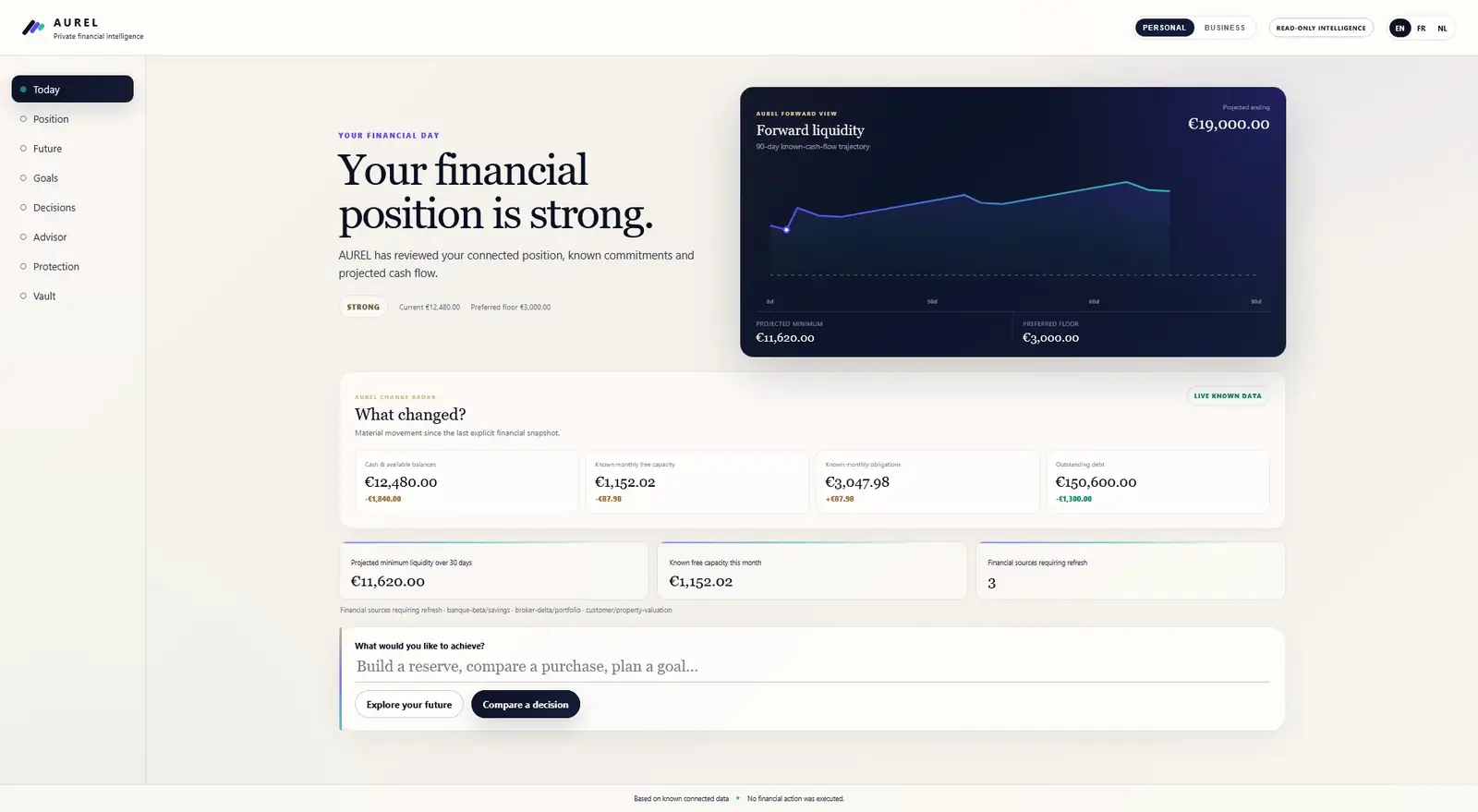
Large product views show how information, roles and actions actually work together.
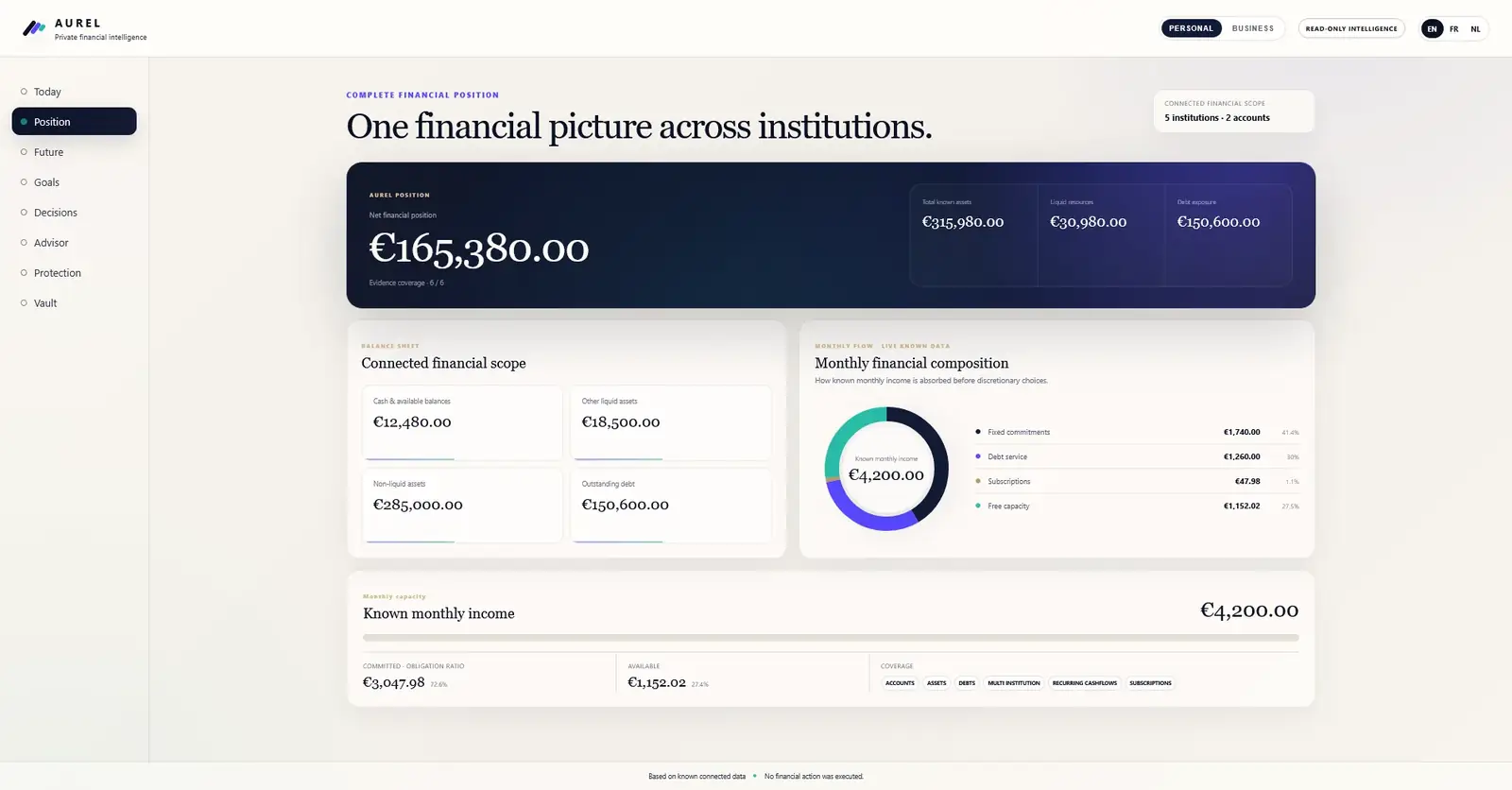
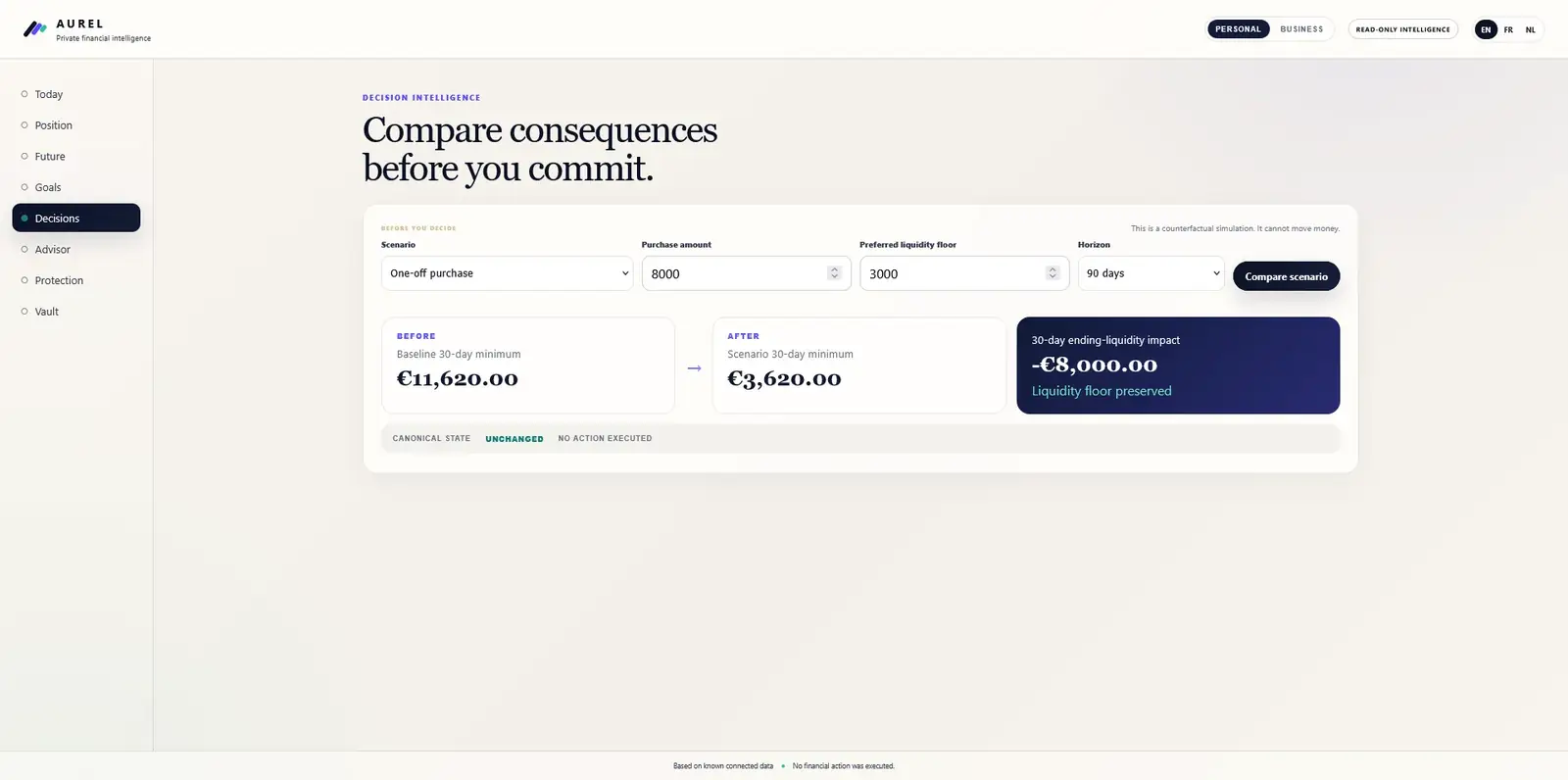
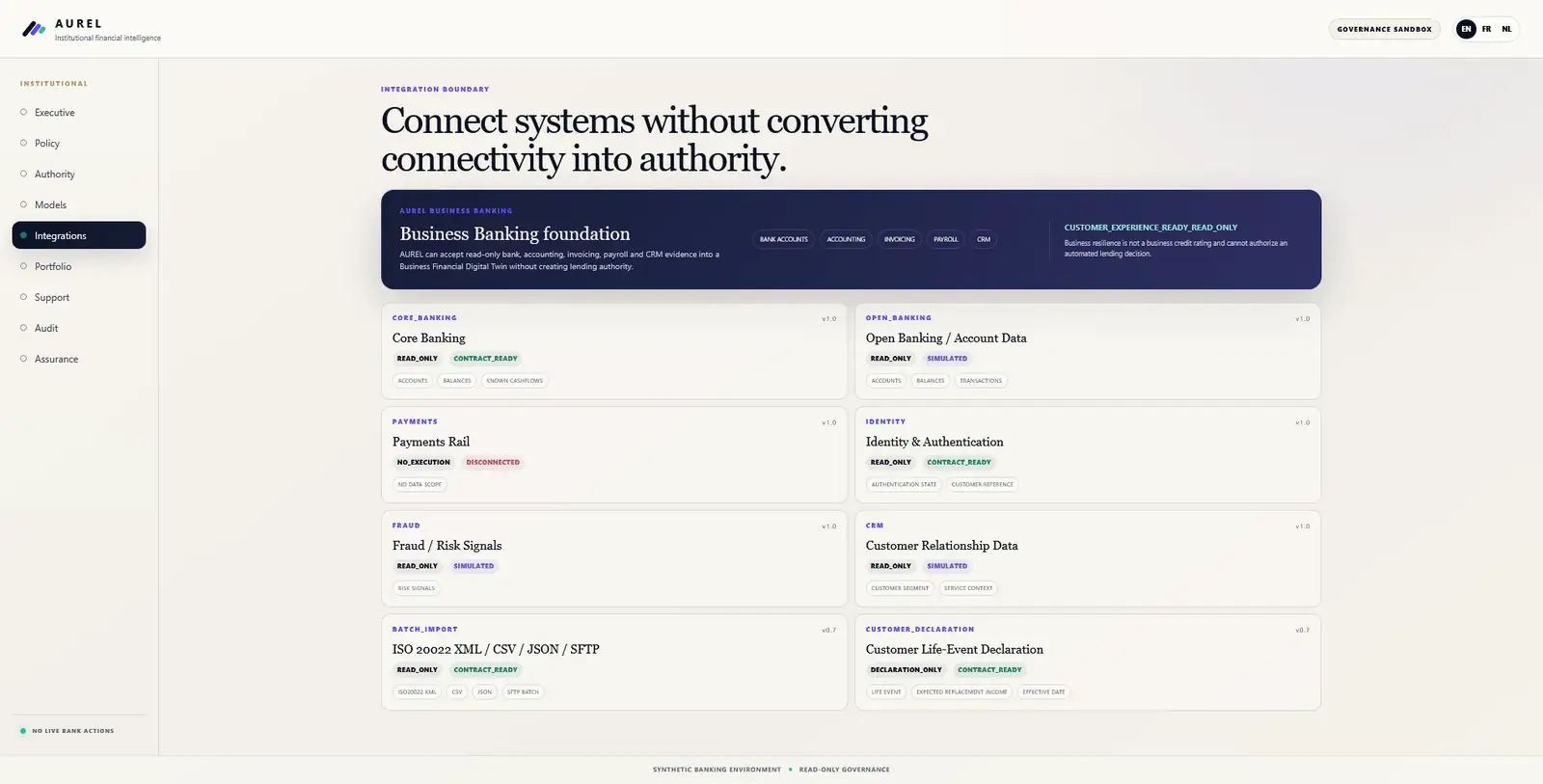
A current balance alone does not show whether a choice remains sustainable thirty, sixty or ninety days ahead. AUREL structures known financial data, exposes assumptions and source quality and compares consequences without changing canonical financial state.
Approved account, accounting, invoicing, payroll, CRM or import sources provide known financial facts within their contractual and technical boundary.
Available resources, other assets, debt, recurring cash flows and commitments are brought into one consistent model.
AUREL calculates known cash-flow trajectories and shows where liquidity buffers may come under pressure.
A goal or hypothetical decision is simulated with contribution, horizon and liquidity impact visible.
The user can question the outcome or prepare a structured briefing; AUREL itself executes no payment, credit or investment action.
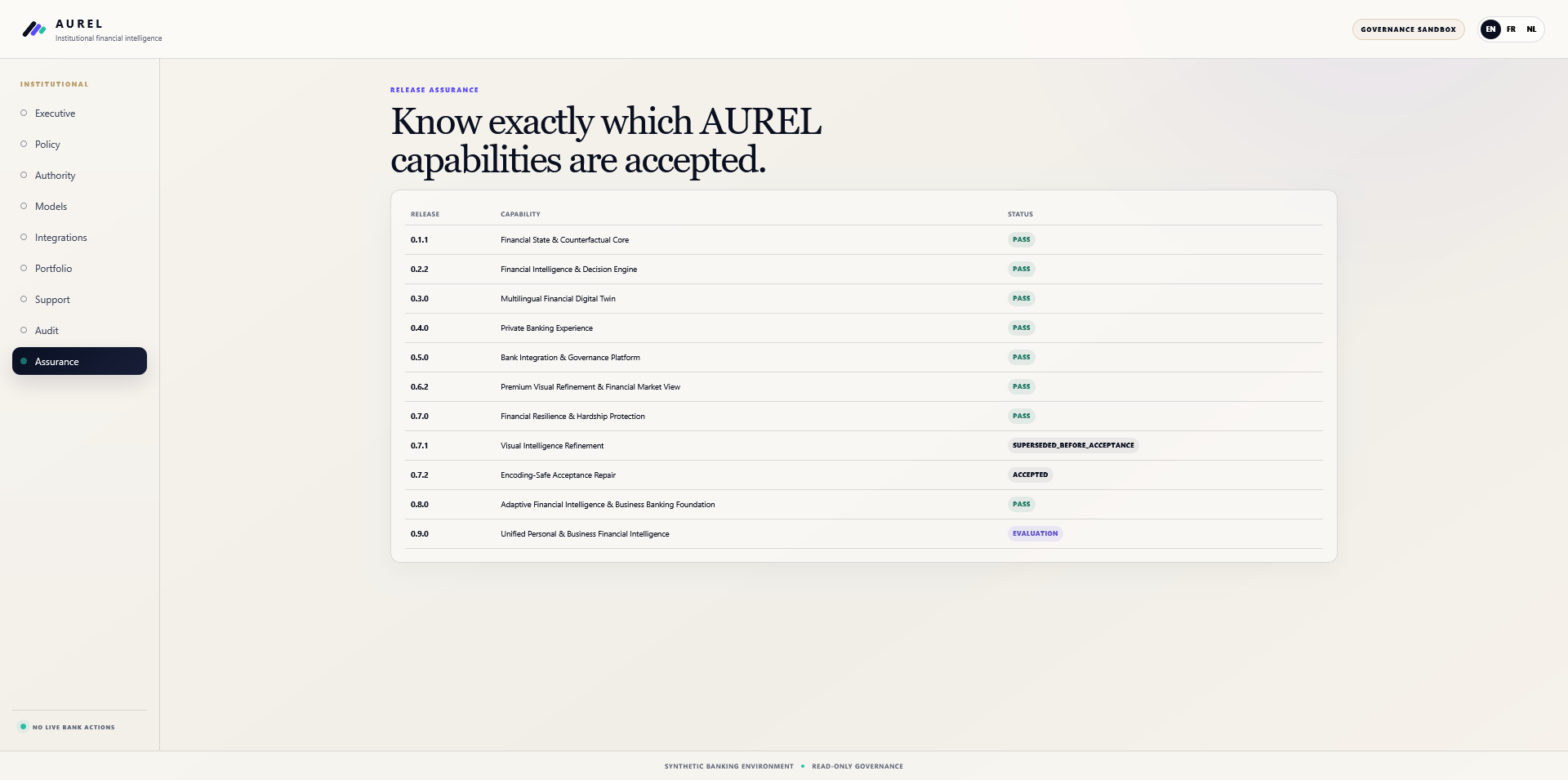
Models, integrations, capability status and release assurance are shown separately so boundaries remain reviewable.
A capability only matters when it makes a real task, decision or hand-off simpler and controllable.
Consolidates known assets, liquidity, debt and monthly composition into one financial picture.
Projects known cash flow and shows minimum liquidity, buffers and pressure points.
Makes target amount, current funding, required contribution and timeline measurable without assuming investment returns.
Compares before/after consequences of a hypothetical choice while canonical state remains unchanged.
Combines forward visibility, data quality and explicit support status without producing a credit score.
Model purpose, authority, integrations, support, audit and release assurance are presented as distinct control layers.
Reviews position, future, goals, decisions, advisor and protection in a read-only intelligence experience.
Can assess business-oriented cash flow and financial context where connected data and capability scope support it.
Receives a user-authorised briefing as a bridge to human advice; real CRM/calendar delivery requires a qualified connector.
Reviews declared purpose, authority boundaries, model status, integrations and release assurance.
AUREL compares the 30- or 90-day position before and after the scenario without changing real financial state.
A goal becomes remaining amount, required monthly contribution and expected horizon using neutral assumptions.
A life-event simulation shows how known cash flow and buffers respond; adverse credit action remains prohibited.
Institutional views make model purpose, read-only/simulation boundaries, integrations and release acceptance inspectable.
AUREL 0.1 is designed as a Banking Intelligence Foundation. Its core is a canonical Financial State with provenance, freshness, confidence and explicit separation between real state, forecast and counterfactual simulation.
Liquidity, obligations, assets, cash flow, goals and risk indicators come together in a versionable financial model.
Version 0.1 observes, models, forecasts, simulates and explains. No intelligence component may directly mutate external financial state.
Bank policy, customer consent, product capability, risk policy and authentication state jointly determine effective authority; ambiguity defaults back to advice or simulation.
We only name components that are demonstrably used in this product line or implementation.
Machine-readable contract for the canonical Financial State.
Deterministic bootstrap and verification tooling for the 0.1 foundation.
Bank-first B2B2C and Read-before-Act are documented architecture decisions.
Derived values and forecasts must remain traceable to source, time and explanation path.
A small excerpt from the real AUREL 0.1 financial-state schema. Amounts carry currency; freshness and confidence are part of the model rather than hidden assumptions.
AUREL 0.1 · intelligence/financial-state-0.1.schema.json"base_currency": {"type": "string", "pattern": "^[A-Z]{3}$"},
"data_freshness": {
"type": "object",
"required": ["status"],
"properties": {
"status": {"enum": ["CURRENT", "DEGRADED", "STALE", "UNKNOWN"]}
}
},
"confidence": {"type": "number", "minimum": 0, "maximum": 1}AUREL structures financial facts in a canonical model. Deterministic state and forecast functions provide base calculations; scenario and goal models operate above them; advisor and support interfaces use the same known state. Integrations provide evidence or context without automatically granting execution authority.
The institutional interface distinguishes contract-ready, simulated, disconnected and read-only integrations. Screens show core banking, open banking/account data, identity, CRM and batch imports as separate integration boundaries. A connector is only presented as operational when demonstrated for the relevant release.
Current presentation mode for product and governance evaluation with explicit capability status.
A real financial institution requires separate review of data residency, identity, integration contracts, logging, model governance, security and operations.
Any future write or execution capability can only be designed as a separately qualified capability with explicit policy and authorisation; it is not implied by the current read-only product line.
The supplied AUREL interface shows a controlled financial-intelligence environment with explicit read-only, simulation-only and no-live-bank-actions boundaries. Release and capability status are shown separately; this is not a claim of broad production or banking authority.
AUREL 0.1 is an intelligence and governance foundation. Real bank connectivity, payments, credit origination, investment execution and production KYC/AML are outside this foundation and require separate integration and regulatory qualification.
An AUREL briefing can show the personal/business experience alongside institutional model, integration and assurance views. The intended use case determines which financial data, models, controls and deployment questions are relevant.